
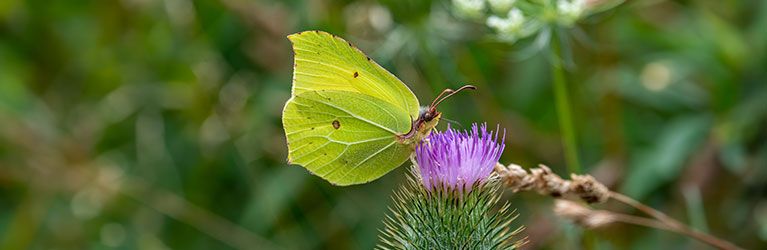
About the Brimstone
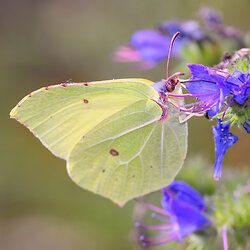
The Brimstone (Gonepteryx rhamni) is one of the first butterflies you may spot as winter begins to loosen its grip. Males are a vivid sulphur-yellow, while females are much paler, with soft greenish-white wings. Both have beautifully veined, leaf-shaped wings that provide excellent camouflage when they settle among foliage.
Brimstones are unusual because they overwinter as adult butterflies. They tuck themselves away in sheltered vegetation through the colder months and can reappear on mild, sunny days surprisingly early in the year. In fact, they may be seen during much of the year, apart from a short lull in early summer between generations.
They’re commonly found along woodland edges, hedgerows, scrubby grassland, roadside verges and in gardens. Brimstones are widespread in England and Wales, much rarer in Scotland, and less common but established in Ireland.
Food for Brimstones
Adult Brimstones feed on nectar from a range of flowers, so gardens with plenty of nectar-rich plants can provide a useful refuelling stop from early spring onwards.
Because they can emerge so early in the year, spring-flowering plants are especially valuable. A mix of flowers that bloom across the seasons helps provide a more reliable supply of nectar for Brimstones and other butterflies.
Planting in sunny, sheltered spots can make your garden even more attractive, giving butterflies somewhere warm to feed and rest.
Plants for Brimstone caterpillars
Brimstone caterpillars are much fussier than the adults. Their main food plants are Buckthorn (*Rhamnus cathartica*) and Alder Buckthorn (*Frangula alnus*), and females lay their eggs directly on these plants so the young caterpillars have food waiting when they hatch.
If you have space, planting one of these native shrubs can be one of the most effective ways to support Brimstones through their full life cycle. Buckthorn tends to prefer more calcareous soils, while Alder Buckthorn is better suited to damp, acidic ground.
Add plenty of nectar-rich flowers nearby and you’ll be creating both a nursery and a dining room for one of our most distinctive butterflies.
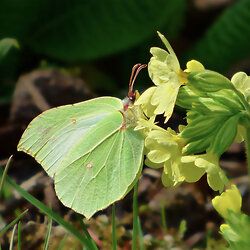
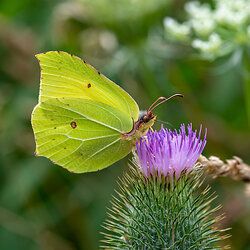
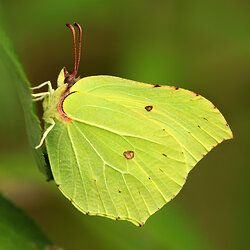
Photo gallery
Our products for butterflies

Facts
| Scientific name |
Gonepteryx rhamni
|
|---|---|
| Family |
Pieridae
|
| Habitat |
Brimstones live along woodland edges, hedgerows, scrub, gardens and flower-rich grassland, particularly where their caterpillar food plants, buckthorn and alder buckthorn, grow nearby. Adults favour sheltered places with plenty of nectar-rich flowers. Their distribution is more localised in some areas because of the availability of suitable habitat and food plants.
|
| Food |
Adult Brimstones drink nectar from a wide range of flowers, with early spring flowers particularly important after they emerge from overwintering. Their caterpillars feed on buckthorn and alder buckthorn, so these shrubs are essential for supporting the complete life cycle.
|
| Length |
5-6cm
|
| Weight |
0,1g
|
| Breeding season |
April
|
| Nest |
Brimstones do not build nests. Females lay their eggs on Buckthorn and Alder Buckthorn, the essential food plants for their caterpillars. Growing these shrubs in suitable sheltered habitats provides the breeding sites needed for the next generation.
|
| Song and call |
Common Brimstone butterflies do not produce a recognisable song or call. Like other butterflies, they are effectively silent to human ears as they fly, feed and interact with one another.
|
| Identification |
Male Brimstones have vivid sulphur-yellow wings, while females are much paler and can appear greenish-white. Both sexes have strongly veined, leaf-shaped wings with a small orange spot on each wing, helping them blend beautifully into foliage when resting.
|
| Broods |
Eggs are laid singly on buckthorn or alder buckthorn. Usually 1 generation each year.
|
Frequently asked questions about the brimstone
Do brimstone butterflies overwinter as adults?
Yes. Brimstones overwinter as adult butterflies, sheltering among dense evergreen vegetation such as ivy and holly.
How long do brimstone butterflies live?
Brimstones are unusually long-lived butterflies and can survive for close to a year because the adults overwinter before breeding the following spring.
How can you attract brimstone butterflies to your garden?
Grow nectar-rich flowers together with buckthorn or alder buckthorn, the essential food plants for brimstone caterpillars.
Are brimstone butterflies rare in the UK?
No. Brimstones are widespread across much of southern Britain and have expanded northwards, although they are less common in some areas.