

About the Orange-tip
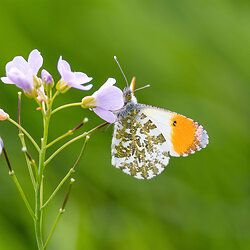
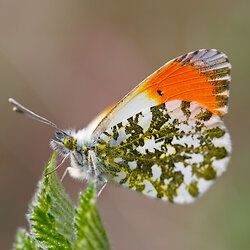
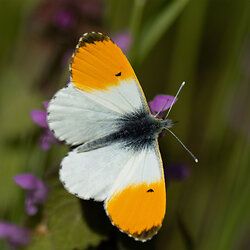
The Orange-tip (Anthocharis cardamines) is a beautiful spring butterfly and one of the easiest to recognise when the males are on the wing. Males have bright white wings with unmistakable orange tips on the forewings, while females lack the orange patches and can look more like other white butterflies at first glance. Both sexes have delicately mottled green markings on the undersides of the hindwings, which provide excellent camouflage when they settle among plants.
Orange-tips are most often seen in spring, flying along hedgerows, woodland edges, meadows, roadside verges and gardens. Males are especially active, patrolling in search of females and rarely seeming to stay still for long.
When resting with their wings closed, the green marbling underneath blends remarkably well with surrounding vegetation. It’s a clever disguise for such a conspicuous butterfly.
Food for Orange-tip Butterflies
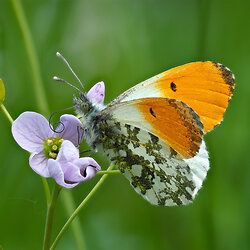
Adult Orange-tips feed on nectar from a variety of spring flowers. Gardens with plenty of early-flowering plants can provide useful feeding stops at a time of year when nectar sources are still relatively limited.
Cuckooflower, Garlic Mustard and other spring flowers can be particularly valuable, while a mix of nectar-rich plants helps support Orange-tips and other pollinators throughout the season.
Sunny, sheltered areas are especially attractive, giving butterflies warm places to feed, rest and gather energy.
Plants for Orange-tip Caterpillars
Orange-tip caterpillars depend on plants from the cabbage family. Two of their most important food plants are Cuckooflower (Cardamine pratensis) and Garlic Mustard (Alliaria petiolata). Females usually lay their eggs singly on the flower stalks, giving the caterpillars immediate access to developing flowers and seed pods when they hatch.
Other suitable plants can include Honesty and Sweet Rocket, making it possible to support Orange-tips even in relatively small garden spaces.
Planting caterpillar food plants alongside nectar-rich flowers is one of the best ways to help Orange-tips complete their full life cycle. A patch of Cuckooflower in damp ground or Garlic Mustard in a lightly shaded corner can turn an ordinary garden into a very welcome spring stopover.
Photo gallery
Our products for butterflies

Facts
| Scientific name |
Anthocharis cardamines
|
|---|---|
| Family |
Pieridae
|
| Habitat |
Orange-tips favour damp meadows, woodland edges, hedgerows, roadside verges and gardens where their caterpillar food plants grow. Cuckooflower is particularly important in damper habitats, while Garlic Mustard is commonly used along hedgerows and woodland edges. Orange-tips are mainly seen during spring and early summer.
|
| Food |
Adult Orange-tip butterflies drink nectar from spring flowers, including Cuckooflower and Garlic Mustard. Their caterpillars feed on plants in the cabbage family, particularly Cuckooflower and Garlic Mustard, as well as suitable garden plants such as Honesty and Sweet Rocket.
|
| Length |
35-45mm
|
| Height |
1g
|
| Breeding season |
March - April
|
| Nest |
Orange-tip butterflies do not build nests. Females usually lay individual eggs on the flower stems of caterpillar food plants such as Cuckooflower and Garlic Mustard. The caterpillars feed on the flowers and developing seed pods, so leaving these plants undisturbed is important.
|
| Song and call |
Orange-tip butterflies do not have a recognisable song or call. Their courtship and other interactions rely mainly on movement, appearance and chemical signals, so these spring butterflies pass through the garden almost silently.
|
| Identification |
Male Orange-tip butterflies have white wings with unmistakable bright orange tips on the forewings. Females lack the orange patches and are mostly white with dark wing tips. Both sexes have beautifully mottled green-and-white undersides on the hindwings.
|
| Broods |
Eggs are usually laid singly on suitable caterpillar food plants. 1 generation each year.
|
Frequently asked questions about the orange-tip
What is the difference between an orange-tip and a white butterfly?
Male orange-tips have unmistakable orange wing tips. Females resemble white butterflies but show a distinctive mottled green pattern beneath the hindwings.
When do orange-tip butterflies fly?
Orange-tips are spring butterflies, normally on the wing from April through May and sometimes into June.
Which plants do orange-tip caterpillars need?
Cuckooflower and garlic mustard are two of the most important food plants for orange-tip caterpillars.
How can you attract orange-tip butterflies to your garden?
Grow cuckooflower and garlic mustard, provide spring nectar sources and avoid cutting or clearing the plants while eggs, caterpillars or pupae are present.