
About the Red Admiral
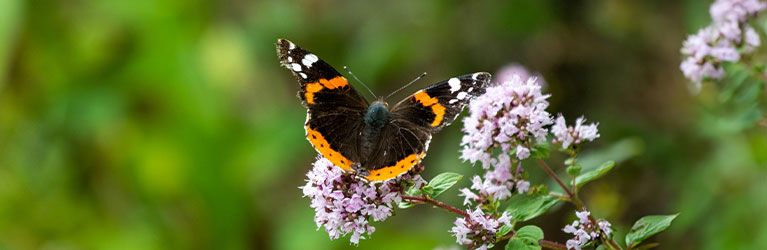
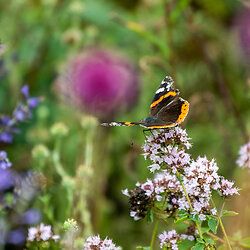
The Red Admiral (Vanessa atalanta) is one of the most striking butterflies found in the UK and Ireland. Its dark wings are marked with bold red bands and bright white spots near the tips of the forewings, creating a pattern that’s hard to miss when it settles in the sunshine. The underside is much more mottled and subdued, providing excellent camouflage when the wings are closed.
Red Admirals can be seen in gardens, parks, woodland edges and the wider countryside. They’re powerful fliers and well known for migration, with butterflies arriving from continental Europe and North Africa. Some can now also survive the winter in Britain and Ireland, particularly during milder conditions.
On warm days, Red Admirals often bask with their wings spread wide to absorb the sun. They’re also quite territorial and may chase other butterflies away from a favourite sunny spot before returning to the same perch.
Food for Red Admirals
Adult Red Admirals feed on nectar from a wide variety of flowers. Gardens rich in nectar-producing plants can therefore provide a valuable food source from spring into autumn.
Later in the year, Red Admirals are also attracted to ripe and fallen fruit, where they feed on sugary juices. Leaving a little overripe fruit in a suitable spot can sometimes tempt them down for a closer look.
A mix of flowering plants that bloom at different times of year gives Red Admirals and other butterflies a more reliable supply of nectar throughout the season.
Plants for Red Admiral caterpillars
Common Nettle is the most important caterpillar food plant for Red Admirals in Britain and Ireland. Females lay their eggs on nettles, and the caterpillars create small shelters by folding or fastening leaves together before feeding inside.
If you have room, leaving a sunny patch of nettles in a quiet corner can provide valuable breeding habitat. It may not look like the most glamorous butterfly garden at first glance, but to a Red Admiral caterpillar, it’s prime real estate.
Combining nettles for caterpillars with plenty of nectar-rich flowers for adults gives Red Admirals both the food and habitat they need to complete their remarkable life cycle.
Photo gallery
Our products for butterflies

Facts
| Scientific name |
Vanessa atalanta
|
|---|---|
| Family |
Nymphalidae
|
| Habitat |
Red Admirals can be found in a wide range of habitats, including gardens, parks, woodland edges, hedgerows and open countryside. They favour places with nectar-rich flowers, nettles for their caterpillars and sunny, sheltered spots for basking. They are most frequently seen from spring into autumn, with numbers boosted by migrating butterflies.
|
| Food |
Adult Red Admirals feed mainly on nectar from a wide variety of flowers and also enjoy sugary juices from ripe or fallen fruit. Their caterpillars feed primarily on nettles, making a combination of nectar-rich flowers and nettle patches especially valuable.
|
| Length |
50-60mm
|
| Weight |
1g
|
| Breeding season |
May - November
|
| Nest |
Red Admirals do not build nests. Females lay their eggs on suitable caterpillar food plants, particularly Common Nettle, and the caterpillars create individual shelters by folding or fastening nettle leaves together. Sunny, sheltered nettle patches provide valuable breeding habitat.
|
| Song and call |
Red Admiral butterflies do not have a song or distinctive call. They are generally silent to us, although the faint movement of their wings may occasionally be noticeable at very close range.
|
| Identification |
Red Admirals have dark brown to black wings crossed by vivid red-orange bands, with bright white spots near the tips of the forewings. The underside is much more mottled and subdued, providing excellent camouflage when the wings are closed.
|
| Broods |
Eggs are laid singly on nettles. Several generations may be produced during favourable seasons.
|
Frequently asked questions about the red admiral
Why is the red admiral a migratory butterfly?
Red admirals are capable migrants, with large numbers arriving in Britain from continental Europe each year. Some now also survive British winters.
What do red admirals eat?
Red admirals drink nectar from flowers and also feed enthusiastically on juices from ripe and rotting fruit.
Which plants do red admirals lay their eggs on?
Red admirals lay their eggs on nettles, which are the main food plant for their caterpillars.