
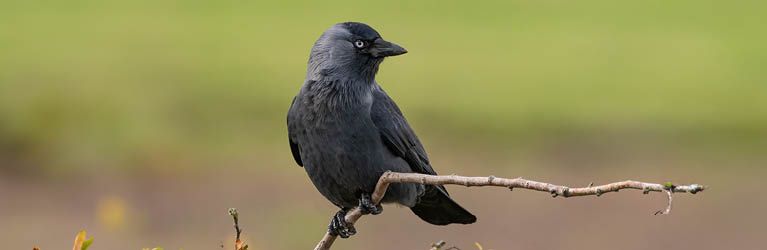
About the jackdaw
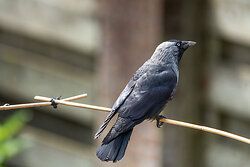
The Jackdaw (Coloeus monedula) is the smallest member of the crow family commonly seen in the UK and Ireland. Its dark plumage can look almost black from a distance, but take a closer look and you’ll spot a contrasting silvery-grey nape and striking pale eyes. These features make Jackdaws surprisingly easy to tell apart from larger crows and Rooks.
Jackdaws are clever, curious and highly sociable birds. They’re often seen in pairs or small groups, and outside the breeding season they may gather in much larger flocks, sometimes roosting alongside Rooks. Their familiar calls are short, sharp and chatty, adding plenty of character to gardens, farmland, villages and towns.
These adaptable birds are equally comfortable foraging in open countryside and living alongside people. They frequently visit gardens in search of food and may briefly drop onto bird tables or feeding areas before moving on again.
Food for Jackdaws
Jackdaws are omnivores, which means they eat a wonderfully varied menu. Their natural diet includes insects and other invertebrates, seeds, fruit and carrion, as well as occasional eggs or small animals. Young Jackdaws rely heavily on protein-rich invertebrates while they’re growing.
In gardens, Jackdaws may be attracted to suitable seeds, suet and other nutritious bird foods. Their size and confidence mean they’re more likely to feed from sturdy bird tables, ground feeding areas and larger feeders than from delicate hanging feeders designed for small birds.
A wildlife-friendly garden can offer even more natural feeding opportunities. Lawns, borders, trees and shrubs provide places to search for insects, while seed-bearing plants and fruit can add extra variety to their diet.
Nesting habitats for Jackdaws
Jackdaws are cavity nesters and are remarkably flexible about where they make their home. Natural nest sites include holes in trees and cliffs, but they’re also well known for nesting in buildings, outbuildings, church towers and suitable chimneys. They may also use a large nest box when a suitable cavity is available.
Because Jackdaws need much more room than smaller garden birds, a standard tit or sparrow nest box won’t do. A spacious nest box designed specifically for Jackdaws or other larger cavity-nesting birds is a better choice.
Positioning a suitable box high up in a quiet, sheltered location can provide a useful alternative where natural cavities are scarce. Jackdaws often form long-lasting pairs and may return to familiar nesting areas, so a successful site can become a regular feature of your local birdlife.
Photo gallery
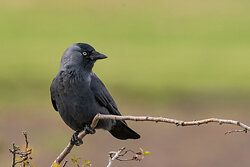
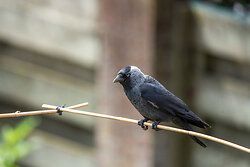
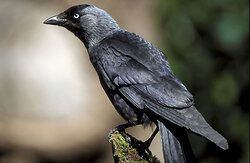
Facts
| Scientific name |
Corvus monedula
|
|---|---|
| Family |
Corvidae
|
| Habitat |
Jackdaws live in farmland, open woodland, parks, villages and towns, often close to mature trees, cliffs or buildings that provide suitable nesting cavities. They are highly adaptable and regularly forage on grassland and around human settlements. Jackdaws are resident and can be seen throughout the year.
|
| Food |
Jackdaws are omnivores and eat insects, earthworms and other invertebrates, seeds, grains, fruit, carrion and occasionally eggs or small animals. In gardens they may take peanuts, seeds, suet and other nutritious foods from sturdy bird tables or ground feeding areas.
|
| Length |
33-34cm
|
| Weight |
180-260g
|
| Lifespan |
1 - 20 Years
|
| Breeding season |
April - Mei
|
| Nest |
Jackdaws nest in large cavities in trees, cliffs and buildings, including towers and suitable chimneys. They may also use large purpose-built nest boxes. Jackdaws need considerably more space and a much larger entrance than small garden birds.
|
| Song and call |
The Jackdaw has a distinctive short, sharp call often described as “jack” or “chack”, which gives the bird its name. Flocks can be wonderfully noisy, with birds constantly calling to one another in flight, while feeding and around communal roosts.
|
| Identification |
Jackdaws are compact members of the crow family with dark grey-black plumage, a contrasting silvery-grey nape and striking pale grey-blue eyes. Males and females look very similar. Young birds are duller and initially have darker eyes.
|
| Broods |
4–6 pale blue eggs with brownish markings. Usually 1 brood in a season.
|
Frequently asked questions about jackdaws
What is the difference between a jackdaw and a carrion crow?
Jackdaws are smaller, with pale eyes and a greyish nape. Carrion crows are larger, completely black and have heavier bills.
Do jackdaws stay with the same partner for life?
Yes. Jackdaws usually form long-lasting pair bonds, and established pairs can remain together throughout the year.
Can you keep a jackdaw as a pet in the UK?
Wild jackdaws are protected and should not simply be taken from the wild and kept as pets. Injured birds should be handled through appropriate wildlife rescue channels.
What do jackdaws eat?
Jackdaws eat insects, worms, seeds, fruit, carrion and food scraps. They are adaptable omnivores and readily exploit food around people.