
About the Magpie
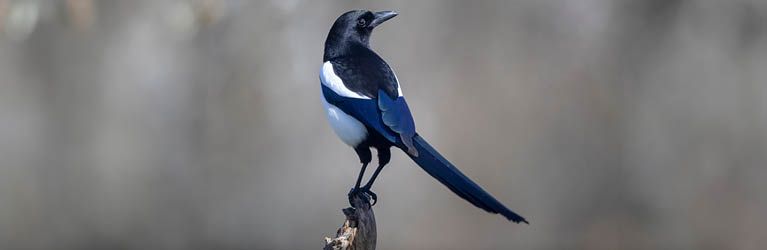
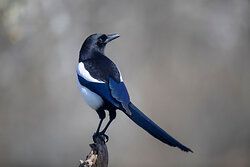
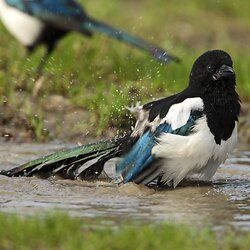
The Magpie (Pica pica) is one of the most distinctive birds in the UK and Ireland. With its bold black-and-white plumage, exceptionally long tail and confident personality, it’s difficult to mistake for anything else. Look more closely and those apparently black feathers reveal beautiful flashes of metallic green, blue and purple in the light.
Magpies belong to the crow family and are intelligent, curious and highly adaptable. They’re common in gardens, parks, farmland and towns, where they can often be heard before they’re seen thanks to their loud, rapid chattering call.
Pairs are frequently seen together during the breeding season, while non-breeding birds may gather in larger groups. Magpies are present throughout the year across most of Britain and Ireland, although they’re much less common in northern and north-western Scotland.
Food for Magpies
Magpies are omnivores and opportunistic feeders, which means they eat a remarkably varied diet. In the wild, they feed on insects and other invertebrates, seeds, fruit and carrion, as well as occasionally taking eggs, young birds and other small animals.
In gardens, Magpies may visit bird tables, ground feeding areas and sturdy feeders for suitable seeds, suet and other foods. Their curious nature means they’re rarely shy about investigating a promising meal.
You can also support their natural feeding behaviour by maintaining a varied garden with lawns, shrubs, trees and insect-friendly planting. These habitats provide plenty of opportunities to forage for invertebrates and other natural foods.
Nesting habitats for Magpies
Magpies do not nest in cavities and therefore won’t use a traditional nest box. Instead, they build large, sturdy nests high in trees or tall shrubs. The nest is made mainly from twigs and often has a distinctive domed roof, with a softer inner cup lined with materials such as soil and plant matter.
Providing mature trees, dense shrubs and undisturbed areas gives Magpies suitable places to nest and shelter. Because their nests are substantial, they need strong branches and plenty of cover rather than an artificial nesting box.
Love them for their intelligence or simply admire their striking plumage, Magpies are fascinating birds to watch and an unmistakable part of everyday wildlife across much of the UK and Ireland.
Photo gallery
Facts
| Scientific name |
Pica pica
|
|---|---|
| Family |
Corvidae
|
| Habitat |
Magpies live in farmland, parks, gardens, woodland edges and urban areas, favouring landscapes with a mixture of open ground and trees or tall shrubs. Mature vegetation provides important nesting sites, while lawns and fields offer plenty of feeding opportunities. Magpies are resident and can be seen throughout the year.
|
| Food |
Magpies are omnivores and eat insects, worms and other invertebrates, seeds, fruit, carrion and occasionally eggs, young birds and other small animals. They may also visit garden feeding areas for peanuts, seeds, suet and suitable scraps of bird food.
|
| Length |
44-46cm
|
| Weight |
180-270g
|
| Lifespan |
1 - 21 years
|
| Breeding season |
March-April
|
| Nest |
Magpies build large, sturdy nests high in trees or tall shrubs. Their nests are made mainly from twigs and often have a domed roof, with a softer cup inside. They do not use traditional nest boxes.
|
| Song and call |
The Magpie has a loud, unmistakable chattering call made up of rapid, harsh notes. This rattling sound is often given when the bird is excited or alarmed. Magpies also produce a wider range of quieter calls when communicating with their partner or family.
|
| Identification |
Magpies have bold black-and-white plumage and an exceptionally long tail. In sunlight, the dark feathers reveal metallic green, blue and purple tones. Males and females look very similar, although males are usually slightly larger.
|
| Broods |
5–8 pale blue-green eggs with brown or grey markings. Usually 1 brood in a season.
|
Frequently asked questions about magpies
Are magpies harmful to songbirds?
Magpies sometimes take eggs or nestlings, but this is a natural part of their diet and is not regarded as a major driver of songbird population declines.
Are magpies protected in the UK?
Yes. Magpies are protected under UK wildlife legislation, although specific legal provisions can apply in certain circumstances.
Do magpies really steal shiny objects?
Not really. Magpies are naturally curious and may investigate unusual objects, but research does not support the popular idea that they have a particular obsession with shiny things.
Are there more magpies than there used to be?
Magpie numbers increased substantially during the twentieth century before becoming more stable. Local numbers vary, which can make them seem particularly abundant in some areas.