

About the Ring-necked Parakeet
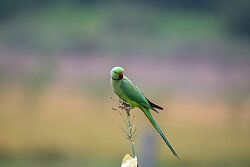
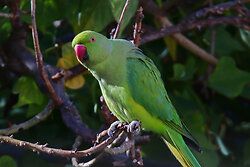
The Ring-necked Parakeet (Psittacula krameri) is hard to miss. With its bright green plumage, long pointed tail and vivid red bill, this colourful parrot brings a distinctly tropical look to parks and gardens. Adult males develop a narrow black and pink collar around the neck, while females and younger birds lack the complete ring.
Originally native to parts of Africa and southern Asia, Ring-necked Parakeets became established in Britain following escapes and releases from captivity. They are now particularly familiar in London and south-east England, although their range has expanded into other towns and cities. They are far less established in Ireland, so sightings there remain much more localised.
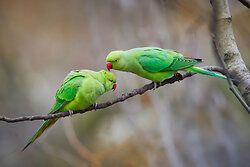
Ring-necked Parakeets are highly sociable and are often seen flying in noisy groups between feeding and roosting sites. Their loud, screeching calls can give them away long before their flash of green appears overhead. Large numbers may gather together at communal roosts outside the breeding season.
Food for Ring-necked Parakeets
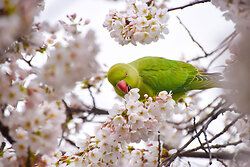
Ring-necked Parakeets eat a varied plant-based diet that includes fruit, berries, seeds and nuts. Their powerful curved bills are excellent tools for cracking open tough foods, while their dextrous feet help them hold and manipulate food as they eat.
Where they are established, Ring-necked Parakeets can become confident garden visitors. They may investigate bird tables and sturdy feeders offering suitable seeds, nuts and fruit, sometimes arriving in lively groups that are difficult to overlook.
Fruit-bearing trees and shrubs can also provide natural feeding opportunities, while a varied wildlife-friendly garden supports plenty of food for other visiting birds too.
Nesting habitats for Ring-necked Parakeets
Ring-necked Parakeets are cavity nesters and usually breed in holes in mature trees. Unlike woodpeckers, they generally rely on existing cavities rather than excavating an entirely new nest hole themselves.
They can also use suitable cavities in parks, gardens and other urban green spaces. Because these nesting sites may also be attractive to native cavity-nesting wildlife, retaining a good supply of mature trees and natural holes helps provide more nesting opportunities across the wider bird community. Research has investigated competition between parakeets and native species, although BTO notes that negative effects on native hole-nesting birds have not been demonstrated in Britain to date.
With their brilliant green feathers, noisy personalities and unmistakably parrot-like appearance, Ring-necked Parakeets are certainly one of the more unexpected birds you might encounter close to home.
Photo gallery
Facts
| Scientific name |
Psittacula krameri
|
|---|---|
| Family |
Psittaculidae
|
| Habitat |
Ring-necked Parakeets favour parks, gardens, tree-lined streets and other urban or suburban areas with plenty of mature trees. Large old trees provide valuable feeding, roosting and nesting opportunities. Their distribution is highly localised, with established populations concentrated in particular areas rather than being widespread.
|
| Food |
Ring-necked Parakeets mainly eat seeds, nuts, fruit, berries, buds and other plant material. Where they visit gardens, they may take sunflower seeds, peanuts, other unsalted nuts and fresh fruit from sturdy bird tables and feeders.
|
| Length |
40-42cm
|
| Weight |
95-140g
|
| Lifespan |
1 - 34 years
|
| Breeding season |
January - June
|
| Nest |
Ring-necked Parakeets nest in cavities, usually using existing holes in mature trees rather than building an open nest. Large old trees with natural cavities are particularly important. They may occasionally use suitably sized artificial nesting cavities.
|
| Song and call |
The Ring-necked Parakeet has a loud, piercing and unmistakable screeching call. Birds frequently call while flying, so they are often heard before their bright green plumage comes into view. Groups gathering at feeding or roosting sites can be particularly noisy.
|
| Identification |
Ring-necked Parakeets are bright green parrots with long pointed tails and strong red bills. Adult males develop a narrow black and pink neck ring, while females and young birds lack the complete collar. Their long wings and tail give them a streamlined shape in flight.
|
| Broods |
3–4 white eggs. Usually 1 brood in a season.
|
Frequently asked questions about the ring-necked parakeet
Why are ring-necked parakeets found in the UK?
Britain's wild ring-necked parakeets originate from escaped and released captive birds. They established breeding populations and are now particularly widespread in London and parts of south-east England.
How many ring-necked parakeets live in the UK?
There are many thousands of ring-necked parakeets in the UK, with the largest concentrations in London and south-east England. Their range has continued to expand.
What do ring-necked parakeets eat?
Ring-necked parakeets eat seeds, nuts, buds, fruit and berries. In gardens they readily take peanuts, sunflower seeds and other bird foods.
How can you stop ring-necked parakeets eating all the bird food?
Use feeders surrounded by a protective cage designed to admit smaller birds while excluding larger species such as parakeets. Choosing smaller feeder ports can also help.
Do ring-necked parakeets breed in nest boxes?
They naturally nest in tree cavities and may investigate sufficiently large nest boxes. Their powerful bills can enlarge wooden entrances, so robust construction is important.