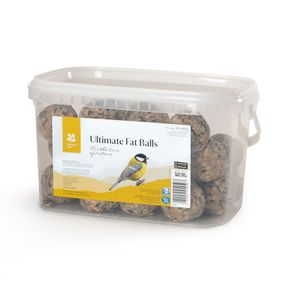
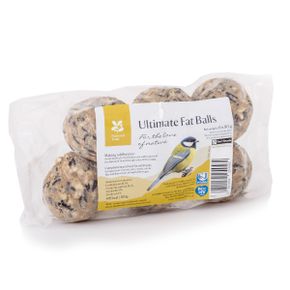
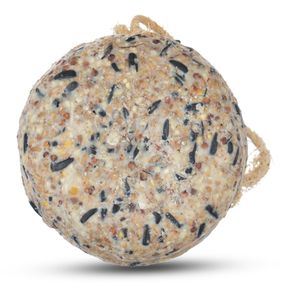
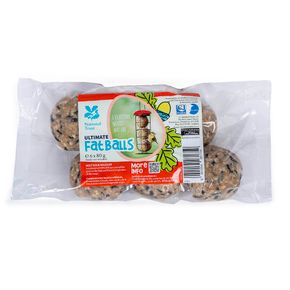
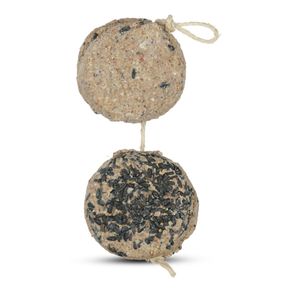
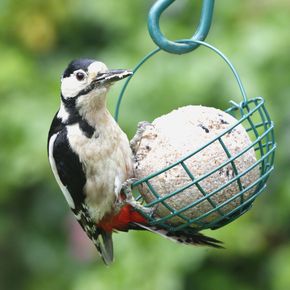
Fat balls are a compact blend of fat and seeds that supplies vital calories in winter and helps during the spring breeding season. All CJ Wildlife fat balls are supplied without nets.
Birds can catch their claws, toes and beaks in the plastic mesh around fat balls, and the empty nets can end up as litter in the garden. That is why we never use nets for our fat balls. We develop our recipes with our own ornithologists and in collaboration with conservation partners such as National Trust.
CJ Wildlife fat balls are energy-rich, made with high-quality fats and without low-value fillers. Some cheaper fat balls bulk out the fat with cereal waste and indigestible ingredients. Uneaten food falls to the ground and can attract rats.
Which fat balls are suitable for which birds?
| Type |
Particularly suitable for |
| Standard fat balls |
Great tits, blue tits, sparrows, nuthatches |
| Premium fat balls |
High energy needs in winter, busy feeding stations |
| Peanut fat balls |
Tits, nuthatches, woodpeckers |
| Fat balls with insects |
Robins, wrens, blackbirds |
One point that is often overlooked: robins and blackbirds cannot cling to a hanging fat ball in the same way as tits. For these birds, place the ball or crumbled pieces on a bird table or in a fat ball feeder. Hanging fat balls alone are unlikely to attract these species.
Premium fat balls contain more high-quality fat, provide considerably more energy than the standard version, stay soft even in freezing temperatures and are around 20% larger.
How to feed fat balls correctly
Hang the fat balls in a suitable feeder near trees or shrubs, so birds have cover, but not so close that cats can creep up unseen. As a guide, one or two fat balls per feeding spot are enough. Several smaller feeding stations around the garden are better than one very busy one.
In summer: Fat can soften and drip in hot weather. Place fat balls in the shade and replace them more frequently to prevent them from going rancid.
Storage: Keep cool and dry. Unopened fat balls will generally keep for several months. Check the best-before date on the packaging.
Hygiene at the feeding station
Many birds gather close together at feeding stations. Pathogens such as Trichomonas, which particularly affects greenfinches, and Salmonella can spread through droppings and damp food scraps.
Clean your fat ball feeder with hot water about once a week and let it dry completely. Remove any fallen crumbs beneath the feeding station. This is also the most effective way to discourage rats, pigeons and squirrels. A hanging bird feeder with a catch tray can make this easier.
Frequently asked questions about fat balls
Are fat balls in nets dangerous for birds?
Yes, fat balls in plastic nets can be dangerous. Birds may catch their claws, toes or beaks in the mesh, while empty nets are left behind as plastic litter. That is why CJ Wildlife always offers fat balls without nets.
Are organic fat balls better for birds?
Organic fat balls are certified to EU organic standards and produced without synthetic pesticides. This is particularly relevant to soil, insects and bees in the garden. For birds, their nutritional value is comparable to other fat balls, provided those are also free from low-value fillers.
Can I offer fat balls in summer?
You can offer them in summer, but only in the shade and with more frequent replacement. Fat softens in the heat and can go rancid. Avoid whole peanuts in summer, as young birds may choke on them. In general, we recommend not hanging fat balls in summer. Several other types of bird food are more suitable.
When should I feed fat balls?
They are particularly important in winter, when birds need plenty of energy to regulate their body temperature. In spring, insect- and mealworm-rich varieties can be useful when parent birds are looking for protein-rich food for their young.
What is the difference between standard and premium fat balls?
Premium fat balls contain more high-quality fat, are significantly more energy-rich, remain soft in cold weather and are around 20% larger. Standard fat balls are sufficient for everyday supplementary feeding.